





Cost, Savings and ROI of Bidirectional Solar Inverters
- Understanding bidirectional energy systems: roles and applications
- What is a bidirectional solar inverter?
- Common applications and value streams
- Cost components of bidirectional solar inverters
- Capital costs: hardware, installation and integration
- Operational costs, efficiency and lifecycle
- Quantifying savings and ROI: methodologies and examples
- How I calculate ROI: key variables and formula
- Example calculations: three representative scenarios
- Technical, regulatory and market considerations
- Standards, safety and certifications
- Incentives, tariffs, and V2G regulations
- How I select and specify bidirectional inverters for projects
- Key selection criteria
- Balance of project economics vs technical complexity
- About Guangzhou Congsin and how we fit into project needs
- Final recommendations and procurement checklist
- Before you buy
- When to choose bidirectional solutions
- FAQ — Frequently Asked Questions
- 1. What is the main difference between a bidirectional solar inverter and a hybrid inverter?
- 2. How much extra does a bidirectional inverter cost compared to a standard grid-tied inverter?
- 3. Can I retrofit my existing solar system with a bidirectional inverter?
- 4. Will a bidirectional inverter shorten my battery life because of more cycling?
- 5. Are there incentives for installing bidirectional inverters or V2G systems?
- 6. How do I estimate payback for my specific site?
As an experienced consultant in power inverters and renewable energy economics, I often see confusion about whether bidirectional solar inverters are worth the extra upfront cost. In this article I summarize how bidirectional converters—able to convert DC→AC and AC→DC energy flows—alter the cost structure of solar-plus-storage, electric vehicle integration, and backup systems. I walk through capital and operating cost elements, quantify savings drivers (self-consumption, demand charge reduction, time-shifting, V2G/V2H), and demonstrate ROI calculations with realistic examples. I also cover technical, regulatory and certification considerations you must check before procurement.
Understanding bidirectional energy systems: roles and applications
What is a bidirectional solar inverter?
A bidirectional solar inverter allows energy to flow both from DC sources (solar panels, battery) to the AC grid or loads and from AC to DC to charge batteries or electric vehicles. This differs from a conventional unidirectional grid-tied inverter that only injects AC to the grid. Bidirectional functionality enables features such as battery charging/discharging, vehicle-to-home (V2H) and vehicle-to-grid (V2G) operations, and advanced energy management for increased self-consumption and resilience. For a general primer on inverters and their role in power systems see Inverter (electrical) — Wikipedia.
Common applications and value streams
Key use cases that create value from bidirectional inverters include:
- Solar-plus-storage for time-shifting and outage resilience (store midday solar, discharge in evening).
- Peak shaving and demand charge management in commercial sites.
- V2G and V2H: using EV batteries as flexible storage assets to provide grid services or home backup.
- Islanded/off-grid operation where the inverter manages multiple power sources and loads.
Cost components of bidirectional solar inverters
Capital costs: hardware, installation and integration
When I evaluate a project, I separate the capital cost into hardware, balance-of-system (BOS), and integration/commissioning:
- Hardware: the bidirectional inverter itself; prices vary by power rating, topology (single/three-phase), degree of integration (inverter + battery charger + EMS), manufacturer and certifications.
- BOS and installation: switchgear, breakers, wiring, DC/AC isolators, metering for export/import accounting, and skilled labor; adding V2G capability usually increases wiring and metering complexity.
- Integration and software: energy management systems (EMS), communications, and in some cases aggregator onboarding for V2G/ancillary services.
Typical retail price ranges (indicative; regional variation applies):
| Component | Residential (typical) | Commercial / Fleet |
|---|---|---|
| Bidirectional inverter (2–10 kW) | $1,200–$6,000 | $6,000–$30,000+ |
| Installation & BOS | $800–$4,000 | $5,000–$50,000+ |
| EMS / Integration & commissioning | $300–$2,000 | $2,000–$40,000+ |
Sources for typical component cost behavior and market context include government overviews and industry reports; see the U.S. Department of Energy’s explanation of solar inverters and distributed energy resources for context: Solar Inverters Explained — U.S. DOE.
Operational costs, efficiency and lifecycle
Operational expenditures include maintenance, firmware updates, replacement parts, and inverter efficiency losses. Bidirectional inverters tend to be slightly more complex, adding potential maintenance points, but modern designs have efficiencies comparable to high-quality unidirectional inverters (typically 95%–98% round-trip efficiency when combined with batteries and power electronics).
When doing life-cycle cost analysis I use a conservative operational loss and maintenance allowance—typically 0.5%–2% of capital per year for residential and a higher fraction for complex commercial deployments. Standards for safety and performance such as IEC 62109 (safety of power converters) and IEEE publications provide essential guidance; see IEC/IEEE resources for technical compliance guidelines. For general grid and storage policy context, I also refer to NREL materials on energy storage: NREL — Energy Storage.
Quantifying savings and ROI: methodologies and examples
How I calculate ROI: key variables and formula
Return on investment for a bidirectional inverter system depends on several measurable variables:
- Capital expenditure (CAPEX): inverter + BOS + installation + EMS.
- Operational expenditure (OPEX): maintenance, replacements, and efficiency losses.
- Energy bill savings: increased self-consumption of solar, avoided purchase at higher tariff periods, reduced demand charges.
- Revenue streams: export tariffs, participation in frequency regulation, V2G remuneration where available.
- Incentives and tax credits: investment tax credits, rebates for storage or smart inverters.
- Project lifetime and discount rate.
Simplified ROI metrics I use: payback period (years to recover CAPEX through net annual savings) and net present value (NPV) over project lifetime. A basic payback formula:
Payback (years) = CAPEX / Annual net savings
Where annual net savings = (energy-cost savings + revenues + avoided demand charges + incentives) − OPEX.
Example calculations: three representative scenarios
Below I present three compact case studies using conservative but realistic inputs. Electricity price and demand assumptions are consistent with U.S. and international ranges; for national price context consult the U.S. EIA: U.S. EIA.
| Scenario | Assumptions | Annual Savings / Revenues | Estimated Payback |
|---|---|---|---|
| Residential solar + 10 kWh battery (time-shift) | CAPEX incremental for bidirectional inverter vs standard: $2,000; annual energy bill reduction $600; maintenance $100/yr | $600 − $100 = $500 | 4 years (simple payback); NPV positive over 10–15 years |
| Commercial site (demand charge reduction) | CAPEX incremental $20,000; demand charge savings $8,000/yr; OPEX $1,000/yr | $8,000 − $1,000 = $7,000 | ~2.9 years |
| EV fleet with V2G participation (aggregated) | Incremental inverter & integration $50,000; revenues from grid services $15,000/yr; OPEX $2,500/yr | $15,000 − $2,500 = $12,500 | ~4 years |
These examples show that ROI is highly project-dependent: where demand charges are significant or where grid-service revenues exist, payback can be very fast. For residential customers the primary value often comes from time-of-use arbitrage and resilience; commercial customers frequently see the strongest economic case due to demand charge avoidance. For more nuanced modeling, industry analysts often use NREL’s System Advisor Model (SAM) for solar-plus-storage financial projections: NREL — SAM.
Technical, regulatory and market considerations
Standards, safety and certifications
When procuring bidirectional inverters, prioritize units with robust safety certifications: IEC 62109 for power converters, ISO 9001 quality systems, CE/EMC/LVD for Europe, UL/ETL for North America, and RoHS for environmental compliance. Device interoperability and communications (Modbus, CAN, OCPP for EV integrations) are equally important for long-term flexibility.
Certifications show compliance with safety and electromagnetic compatibility requirements; check manufacturer datasheets and certification documents. Grid connection requirements (anti-islanding, anti-export where required) are covered in local interconnection rules—refer to national grid operator or regulator guidance. For international best-practices and standards context, IEEE publications on inverter control and grid-interactive power electronics are a valuable technical reference: IEEE.
Incentives, tariffs, and V2G regulations
Policy significantly affects ROI. Some jurisdictions offer incentives for battery storage or smart inverters; others permit compensation for grid services (frequency regulation, demand response). V2G remains an emerging regulatory area: rules for exporting energy back to the grid, metering, and aggregator participation vary widely. Before committing, confirm the local market rules and available tariff structures with your utility or regulator. The International Energy Agency (IEA) publishes analysis on how markets and policies influence storage adoption: IEA.
How I select and specify bidirectional inverters for projects
Key selection criteria
In my procurement checklists, I always include:
- Bidirectional capability and whether the inverter supports simultaneous PV + battery + EV flows.
- Round-trip efficiency and inverter efficiency curves at expected load; lower losses increase realized savings.
- Communications and EMS integration (Modbus, SunSpec, OCPP for EVs).
- Warranty length, service network and firmware update policy.
- Certifications and grid compliance for the project region.
Balance of project economics vs technical complexity
Higher-performing inverters reduce operating losses but cost more upfront. I weigh incremental CAPEX against modeled annual benefits—if demand charge savings or V2G revenues are large, it generally justifies High Quality models. For residential and small commercial projects without complex grid services, a mid-range bidirectional inverter with robust EMS and standard safety approvals is often the best compromise.
About Guangzhou Congsin and how we fit into project needs
Guangzhou Congsin Electronic Technology Co., Ltd., founded in early 1998, is a professional power inverter manufacturer with over 27 years of focused experience. We design, R&D and manufacture a wide range of power solutions—with a core emphasis on DC→AC power inverters, portable power stations, and solar charge controllers. Our catalog includes 100+ models tailored for vehicles, solar systems, RVs and trucks, off-grid homes, outdoor offices, patrol and field construction work.
We operate fully automated production lines, advanced instrumentation and multifunctional testing equipment to ensure product reliability, efficiency and intelligent functionality. Environmental and safety compliance are built in: our quality system is ISO9001 certified and many products hold international approvals such as CE, EMC, LVD, ETL, FCC, RoHS and E-MARK. Several independently developed patents further demonstrate our commitment to innovation.
Congsin’s products serve global markets across Europe, the Americas, the Middle East, Africa and Southeast Asia; many models are supplied to domestic and international OEM channels. Our support includes OEM/ODM, private labeling, distribution and bespoke customization to meet partner specifications.
Our mission is to deliver reliable, efficient and affordable energy solutions that enable energy independence. Key product lines relevant to bidirectional projects include Solar Charge Controllers, modified sine wave inverters, pure sine wave inverters and portable power stations. What differentiates Congsin is the combination of manufacturing depth (27+ years), automated quality control, a wide product range for integration, and flexible OEM/ODM options—making it easier to match equipment to project-unique requirements and regulatory constraints.
Final recommendations and procurement checklist
Before you buy
- Model your project with conservative assumptions for electricity price escalation and battery degradation (use tools like NREL SAM).
- Confirm local grid interconnection rules for export/V2G and available incentives.
- Require clear warranty terms and firmware update commitments from the vendor.
- Ask for test reports and certificates (ISO9001, CE/ETL/UL, RoHS, EMC).
When to choose bidirectional solutions
Choose bidirectional inverters when your project includes any of the following: meaningful demand charges, expectations for EV integration or V2G revenues, strong time-of-use pricing arbitrage potential, or a need for resilient backup capability. If your primary objective is simple solar export with minimal storage, a standard unidirectional inverter may suffice.
FAQ — Frequently Asked Questions
1. What is the main difference between a bidirectional solar inverter and a hybrid inverter?
Terminology varies in the market. A hybrid inverter typically refers to an inverter that can manage PV and battery together; many hybrid inverters are also bidirectional (able to charge and discharge a battery). The key is to confirm that the unit explicitly supports AC→DC charging (from grid to battery or EV) and AC export controls if you need V2G or specific grid services.
2. How much extra does a bidirectional inverter cost compared to a standard grid-tied inverter?
Incremental cost varies by capacity and features but expect roughly 10%–60% higher hardware cost for bidirectional capability compared to a basic grid-tied inverter when considering equivalent power ratings and certifications. The true economic case depends on the savings streams you can unlock with bidirectional operation.
3. Can I retrofit my existing solar system with a bidirectional inverter?
Yes, in many cases you can retrofit but be mindful of compatibility with existing PV arrays, battery chemistry, and wiring. Retrofitting often requires additional BOS work, updated metering, and commissioning. Always consult a qualified installer and verify any grid interconnection paperwork.
4. Will a bidirectional inverter shorten my battery life because of more cycling?
Cycling impacts battery life irrespective of inverter type. A bidirectional inverter enables more active cycling strategies (time-shifting, V2G) which, if not managed correctly, can accelerate degradation. Good battery management systems and smart EMS strategies can optimize cycling to balance revenue and battery longevity. In financial models, include realistic battery degradation curves.
5. Are there incentives for installing bidirectional inverters or V2G systems?
Incentives depend on jurisdiction. Some regions offer rebates or tax credits for energy storage and smart inverters; V2G incentives and market mechanisms are emerging in places with advanced grid services markets. Check local utility programs and national incentives. For international policy context, review resources such as the IEA or national energy agencies.
6. How do I estimate payback for my specific site?
Build a simple cash-flow model: list CAPEX (total installed cost), estimate annual OPEX, model annual savings (energy arbitrage + demand charge reduction + any revenues), apply incentives, and compute payback and NPV over your planned lifetime (typically 10–15 years). Use conservative assumptions for future tariffs and battery degradation. If needed, contact an experienced integrator or use NREL’s SAM tool for detailed simulation.
If you’d like, I can run a project-specific ROI estimate or help specify equipment. For product options and OEM/ODM inquiries, consider Guangzhou Congsin Electronic Technology Co., Ltd. — with 27+ years of manufacturing experience and a wide range of inverters, solar charge controllers and portable power stations, they provide configurable solutions for residential, commercial and mobile energy projects. Contact us to discuss product datasheets, certification evidence and tailored proposals.
Contact / Learn more: reach out for project quotes, product catalogs or technical consultations. View Congsin’s product lines and request OEM/ODM details to match a bidirectional inverter selection to your regulatory region and business model.
China Solar Inverters: Certifications and Quality Standards

7 Critical Errors Your LED Display is Telling You: A 2026 Modified Sine Wave Troubleshooting Manual
Sourcing Reliable Modified Sine Wave Inverter Manufacturers
MPPT Charge Controllers for RVs and Boats: Buyer's Tips
Modified Sine Wave Inverters
What devices can be powered by this inverter?
Suitable for TVs, fans, computers, and small tools.
What is the benefit of the UPS function? A2:
It automatically switches to battery power when AC fails.
Can I customize the color and logo?
Yes, OEM/ODM customization is supported.
Does it have protection features?
Yes, it includes overload, overheat, and short-circuit protection.
OEM & ODM Services
What certifications do your products comply with?
All products meet CE, RoHS, FCC, and other market-specific compliance standards.
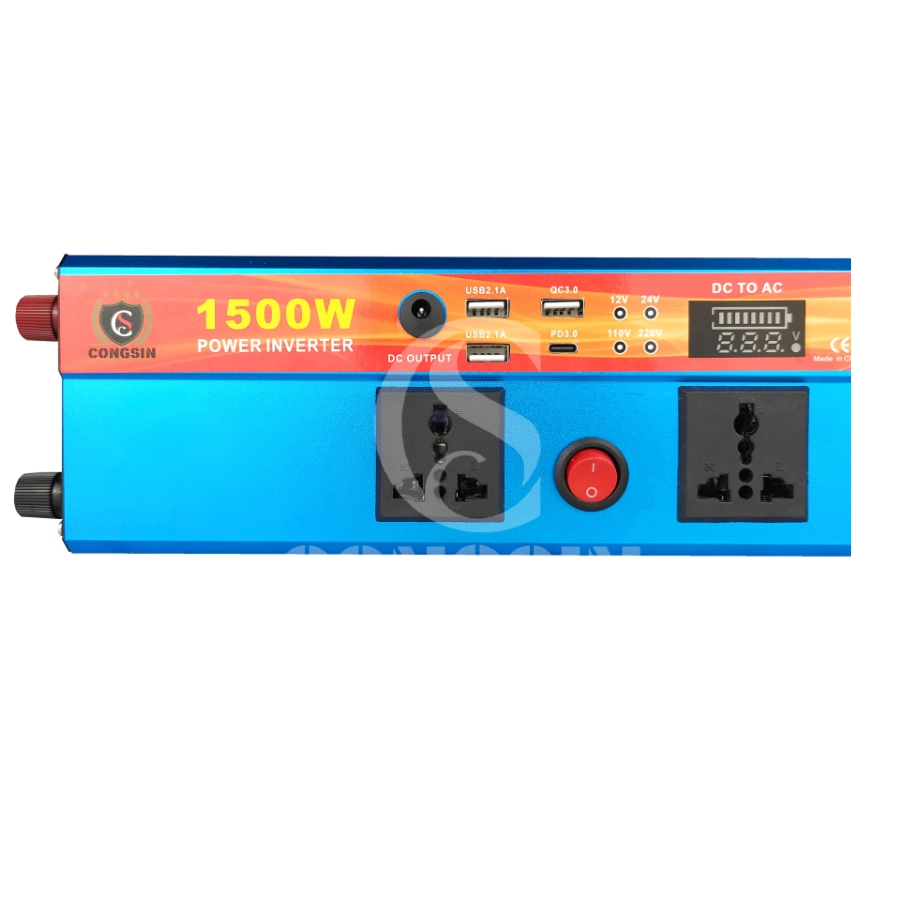
1500W Modified Sine Wave Inverter, DC 12V to AC 220V Power Inverter with LED Display, 3 USB Ports, 1 Type-C, 1 DC 12V Output & Two Universal Sockets
Our CS1000DDBC 1000W modified sine wave inverter is a professional power conversion device that converts DC 12V from batteries into AC 220V electricity. It is designed with user convenience in mind, featuring an LED display for real-time status monitoring, multiple charging ports (3 USB, 1 Type-C, 1 DC 12V) and two universal sockets to power a wide range of devices simultaneously. Its compact size (250×95×55mm) and lightweight design (NW: 0.84kg) make it easy to carry, ideal for outdoor activities, emergency home use, and on-the-go power needs.
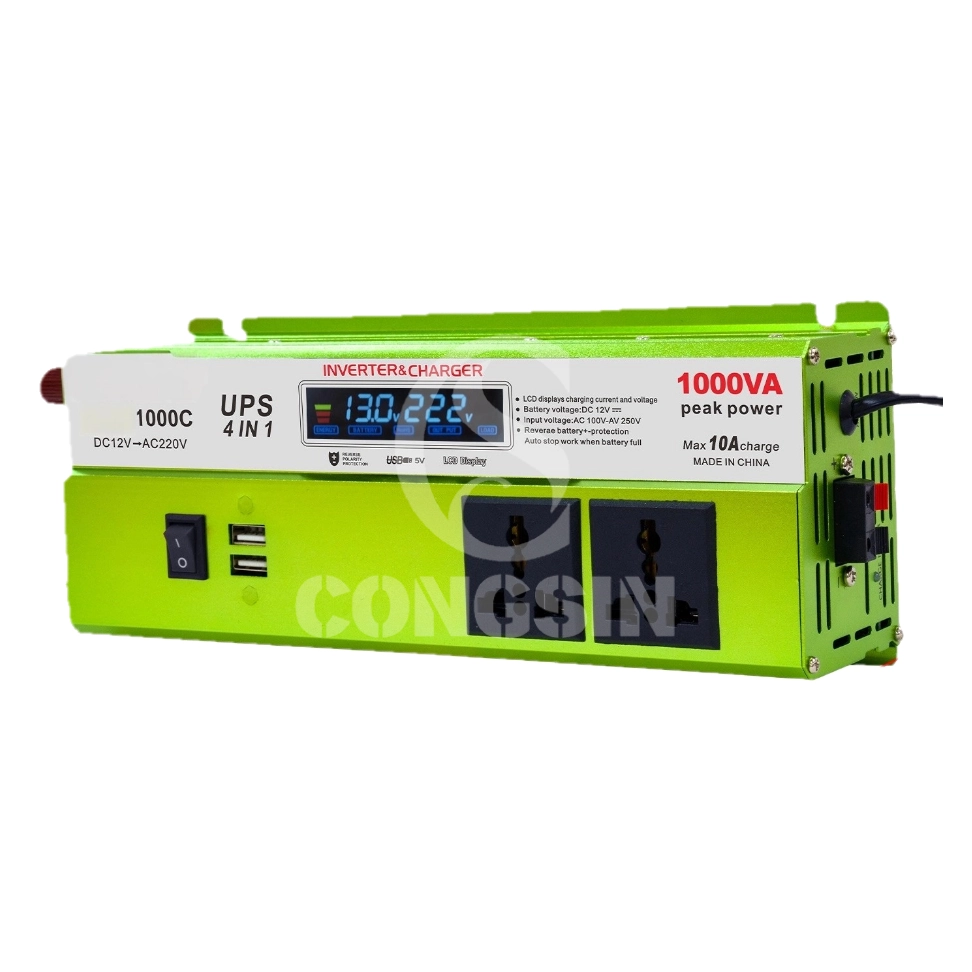
1000W 1500W 2000W UPS POWER INVERTER WITH CHARGER 10A 15A 20A DC TO AC 12v24v 110v 220V
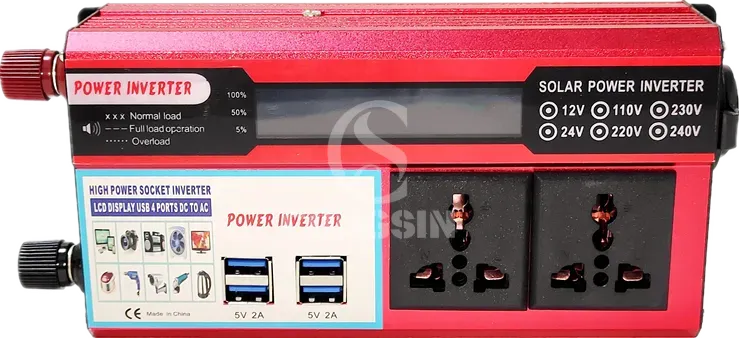
Congsin 500W Modified Sine Wave Inverter with LCD Display of Off Grid System Solar Power Inverter
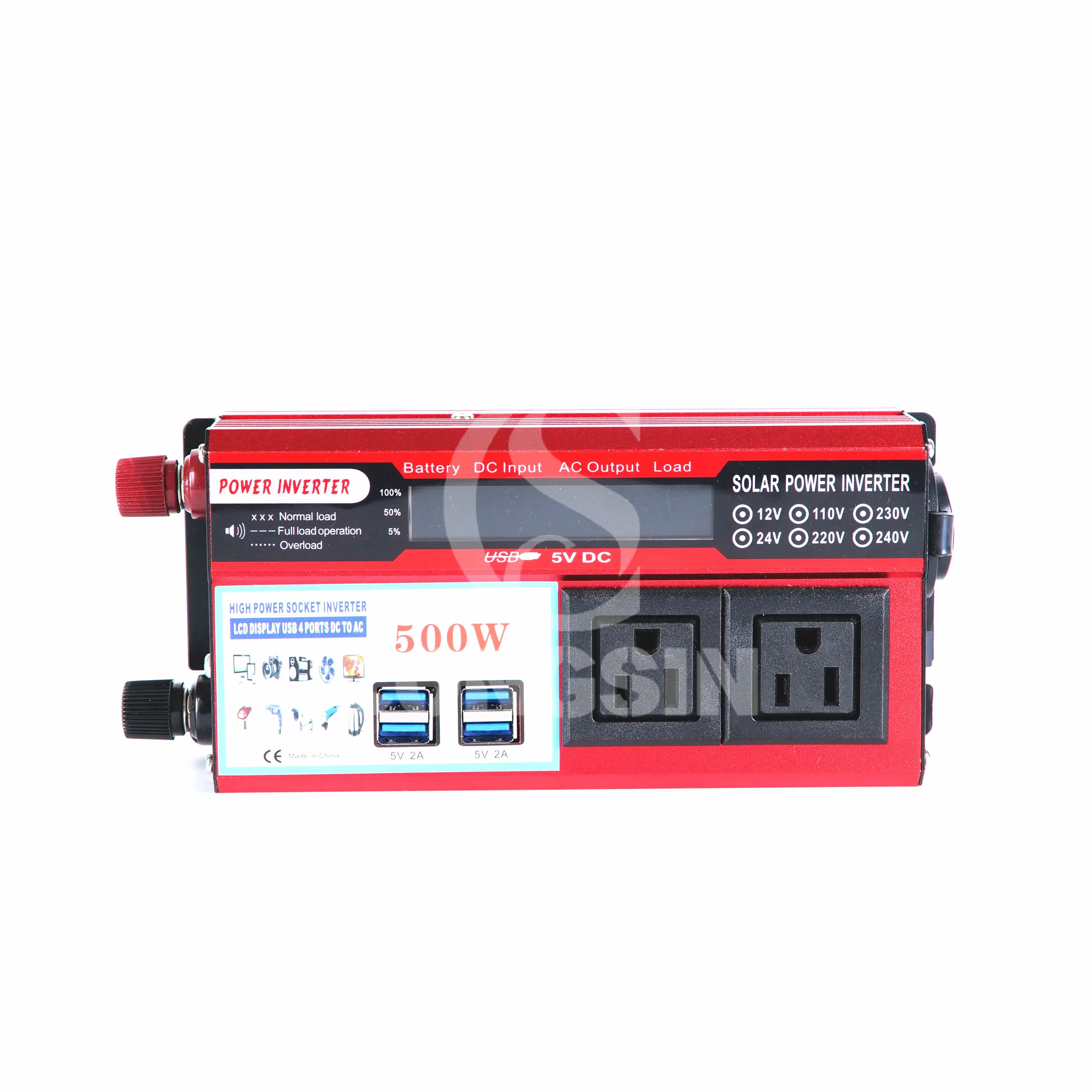
Congsin 500W modified sine wave power inverter US sockets 4 USB ports LCD display off grid

CONGSIN is a trusted OEM factory for power inverters, solar charge controllers, and DC converters. Reliable solutions for global B2B buyers.
 High Quality
 7/24 Service
 Guaranteed Warranty
© 2025 Congsin. All Rights Reserved.